The basics are pretty accessible, but it takes time and practice to master. Fingerboarding rewards fine motor control and consistency, so tricks that look simple can take a while to land well. That is also part of what makes it satisfying. The community is welcoming and there are tons of tutorial videos online to help you progress at your own pace.
FAQ
- Is fingerboarding hard to learn?
- What is fingerboarding?
- Is fingerboarding just a toy, or is it a real hobby?
- How old do you have to be to fingerboard?
- What is the difference between a Tech Deck and a pro fingerboard?
- What do I need to get started with fingerboarding?
- What is the fingerboarding community like?
- Why is pro fingerboard gear expensive?
- What is a fingerboard complete?
- What size fingerboard deck should I get?
- What deck shape should I ride?
- Should I get a wooden deck or a plastic deck?
- How do I attach trucks to my deck?
- What is a "ply" when talking about fingerboard decks?
- How can I make a wooden fingerboard deck?
- How do I poke holes through a heat transfer graphic?
- What is a "heat transfer" or "real wear" graphic in fingerboarding?
- Why are Session decks more expensive?
- What is fingerboard tape and why do I need it?
- How long does foam tape last?
- What tape should I use on my fingerboard deck?
- What is the difference between 0.5mm and 1mm foam tape?
- Will I get a free sheet of tape when I order a fingerboard?
- How to apply foam tape to a fingerboard deck
- How to apply Ducky Tape or Pro Duro Tape to a fingerboard deck
- How to file down the edges of foam tape during application
- What are fingerboard trucks?
- What width trucks should I ride on my fingerboard?
- How Can I Put My Fingerboard Trucks On So They Don't Fall Off?
- What are lock nuts and are they included with trucks?
- What are riser pads in fingerboarding?
- How to avoid stripping your truck holes
- What are pivot cups and how do I install them?
- Which durometer tuning should I use?
- How to install O-Ring Tuning
- How to install Bubble Bushings
- What is "durometer" with fingerboard wheels?
- What is the difference between Teak Tuning's Apex wheels and standard wheels?
- What wheel size and shape should I ride?
- What fingerboard wheels can I ride on a budget?
- Which bearings should I get in my fingerboard wheels? Ultra Spin bearings or ABEC-9 Stealth bearings?
- What if my wheels don't spin?
- My wheels keep falling off. What do I do?
- Why are most fingerboard wheels made of urethane?
- What is "bearing lock" in wheels?
- What are ATP wheels?
- Do I really need fingerboard obstacles or rails?
- What fingerboard obstacles are the best for beginners?
- What is the Monument Series?
- What are Session x Teak obstacles?
- What materials are fingerboard obstacles made of?
- What does acrylic feel like on a fingerboard obstacle?
Fingerboarding Basics
- Is fingerboarding hard to learn?
- What is fingerboarding?
- Is fingerboarding just a toy, or is it a real hobby?
- How old do you have to be to fingerboard?
- What is the difference between a Tech Deck and a pro fingerboard?
- What do I need to get started with fingerboarding?
- What is the fingerboarding community like?
- Why is pro fingerboard gear expensive?
Is fingerboarding hard to learn?
What is fingerboarding?
Fingerboarding is a miniature version of skateboarding where you use your fingers to control a tiny skateboard. Think of it like real skateboarding, but scaled down to desktop size. The board, trucks, wheels, and even the obstacles all mimic their full-size counterparts. You use two fingers, just like a skateboarder would with their feet. It started as a novelty in the 1990s and has grown into a serious hobby with a passionate worldwide community, professional competitions, and high-quality gear built specifically for the craft.
Is fingerboarding just a toy, or is it a real hobby?
It is absolutely a real hobby. While it might look like a toy at first glance, fingerboarding has a thriving global community, dedicated competitions, and professional riders. People of all ages take it seriously, spend time developing their skills, attend events, and compete in compeitions.
How old do you have to be to fingerboard?
There is no minimum age to enjoy fingerboarding, but most fingerboard products contain small parts and are recommended for ages 14 and up due to choking hazard concerns. On the upper end, there is no age limit at all. Plenty of adults in their 20s, 30s, and beyond are active fingerboarders.
What is the difference between a Tech Deck and a pro fingerboard?
Tech Decks are the plastic fingerboards you find at big box stores and toy shops. They are a great way to get introduced to fingerboarding, but they have limitations. The trucks are typically plastic and the wheels don't spin well. Pro fingerboards, like the ones we carry at Teak Tuning, are made from real layered maple wood. The trucks are metal with professional bushings, and the wheels are made from real urethane with steel bearings that spin fast and smooth. The difference in feel is night and day. If you want to actually learn tricks and develop your skills, a pro setup is the way to go.
What do I need to get started with fingerboarding?
The most important thing is a fingerboard. If you are buying your first one, a complete (a pre-assembled board with deck, trucks, and wheels) is the easiest starting point. The Teak Tuning Gen2 Fingerboard Completes are a great place to start.
What is the fingerboarding community like?
The fingerboarding community is welcoming, creative, and genuinely passionate. There are active communities on YouTube, Instagram, TikTok, Reddit, and Discord where people share clips, get feedback, and talk about fingerboarding. There are also fingerboard events, competitions, and conventions held around the world where fingerboarders gather in person. Whether you are a kid just starting out or an adult with years of experience, there is a place for you in the community.
Why is pro fingerboard gear expensive?
Most pro fingerboard products come from small businesses and independent makers who use high-end materials and incredible craftsmanship. Decks are pressed from real maple, wheels are cast from real urethane, trucks are precision machined, and obstacles are hand-made. These are not mass-produced toys. You are paying for quality components that are built to perform, and you're supporting small businesses in the process.
Decks & Completes
- What is a fingerboard complete?
- What size fingerboard deck should I get?
- What deck shape should I ride?
- Should I get a wooden deck or a plastic deck?
- How do I attach trucks to my deck?
- What is a "ply" when talking about fingerboard decks?
- How can I make a wooden fingerboard deck?
- How do I poke holes through a heat transfer graphic?
- What is a "heat transfer" or "real wear" graphic in fingerboarding?
- Why are Session decks more expensive?
What is a fingerboard complete?
A complete is a fully assembled fingerboard that comes with a deck, trucks, and wheels and tape. Completes are great for beginners because you do not have to source each part separately. They are also a solid value since the components are pre-matched for compatibility. The Teak Tuning Gen2 Completes include everything you need, and the deck/trucks/wheels are pre-assembled.
What size fingerboard deck should I get?
Fingerboard decks are measured by their width. At Teak Tuning, our most popular widths are 32mm and 34mm. A 32mm deck is a bit narrower and tends to flip faster and easier. A 34mm deck is slightly wider and has more surface area for landing. Smaller widths like 29mm exist for riders who prefer a tighter feel, and wider options like 35mm and 36mm are available for those who want even larger board. If you are brand new, starting with a 32mm or 34mm is the safe bet for most people.
For a full look at every width we carry including shapes and best trucks to pair with each, check out this blog article: How to Choose The Right Deck Width Explained
What deck shape should I ride?
Beyond the standard popsicle shape, we carry "boxy" decks with a squared-off nose and tail, Carlsbad Cruisers with a pointed nose great for bowl and transition riding, and more.
See the full lineup and reccomendtions for our shapes in this blog article: Which Fingerboard Deck Shape Is Right For Me?
Should I get a wooden deck or a plastic deck?
Wooden decks are the industry standard in fingerboarding. Some companies also offer plastic and polycarbonate decks in multiple colors for a unique secondary setup.
We break down the full comparison here: Wooden Decks or Plastic Decks: Which One Should You Get?
How do I attach trucks to my deck?
Flip the deck upside down, align the baseplate over the pre-drilled holes, thread your screws through, and secure with locknuts from the top. Tighten firmly without over-tightening. A fingerboard tool (included with Teak completes and trucks) makes this easy. If the small hardware is hard to handle, our Complete Builder Vise holds everything steady while you work.
What is a "ply" when talking about fingerboard decks?
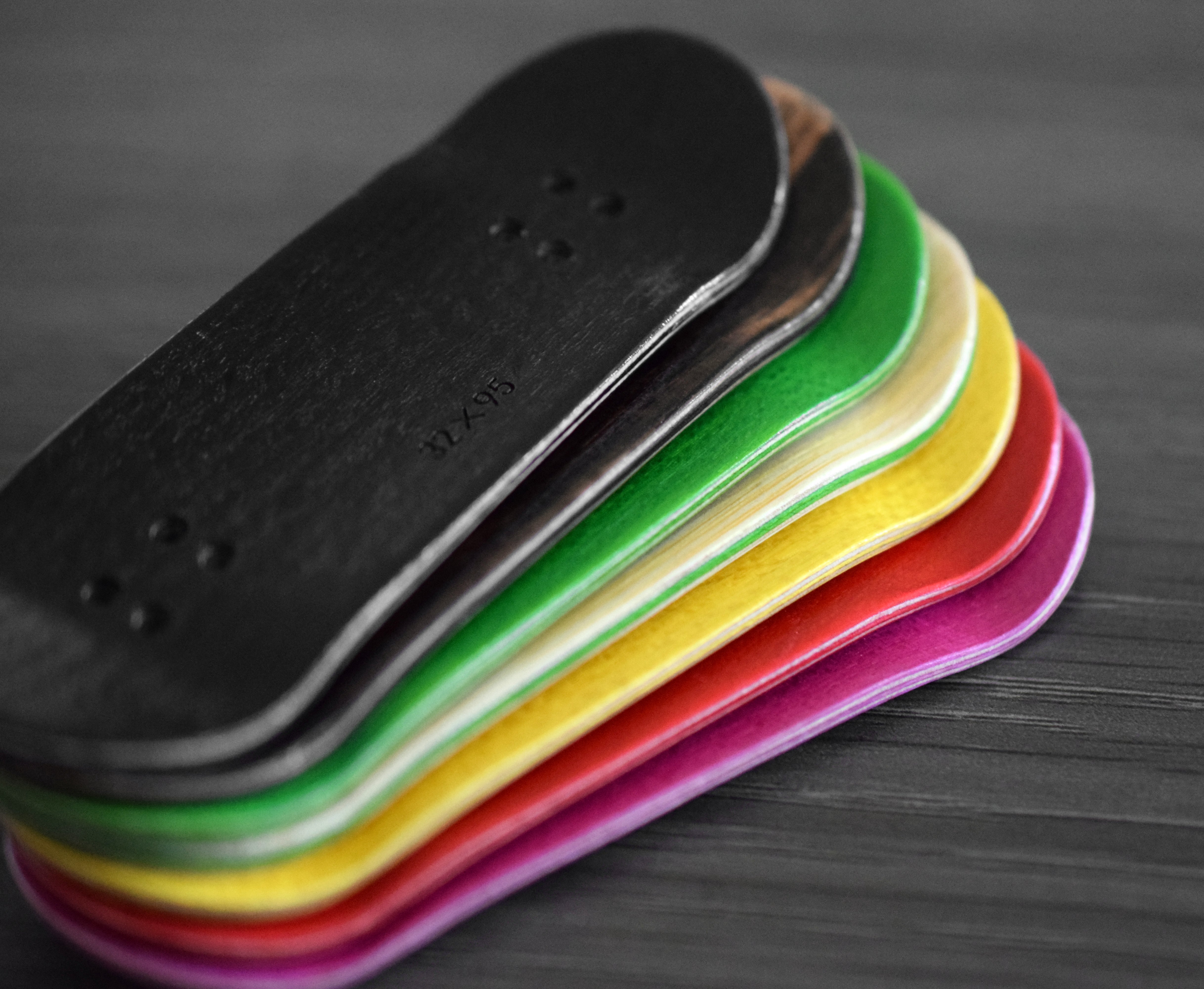
"Ply" refers to the individual wood layers pressed together to form the deck. Most fingerboard decks are 5 plies of cross-grain veneer for added strength and durabiltiy.
How can I make a wooden fingerboard deck?
Making your own decks is a rewarding part of the hobby. The process involves layering and pressing thin sheets of maple veneer together, then cutting, shaping, drilling, and finishing the board once the glue cures. If you want to try it without sourcing all the materials separately, our Complete Deck Construction Kit includes everything you need to press your first deck at home.
How do I poke holes through a heat transfer graphic?
Since the holes are already there in the wood, you are just pushing through the graphic material on top of the wood. You ca use a truck axle, pencil tip, or any slim object. For a full step-by-step walkthrough of the process: How To Poke Holes Through a Heat Transfer Graphic
What is a "heat transfer" or "real wear" graphic in fingerboarding?
A heat transfer graphic is a design that is permanently bonded to the bottom of the deck using heat and pressure, similar to how graphics are applied on real skateboards. "Real wear" means the graphic will naturally scratch, scuff, and wear down over time as you skate, just like a full-size board.
Why are Session decks more expensive?
Session is a sub-brand of Teak Tuning and Session decks are handcrafted from start to finish in Rochester, New York. Every ply is individually cut from carefully chosen veneer, shaped, fully rounded by hand, and finished with a luxurious satin coat that enhances the natural beauty of the wood. The level of craftsmanship and attention to detail that goes into each deck is what sets them apart and justifies the price. Learn more at sessionfingerboards.com
Fingerboard Tape
- What is fingerboard tape and why do I need it?
- How long does foam tape last?
- What tape should I use on my fingerboard deck?
- What is the difference between 0.5mm and 1mm foam tape?
- Will I get a free sheet of tape when I order a fingerboard?
- How to apply foam tape to a fingerboard deck
- How to apply Ducky Tape or Pro Duro Tape to a fingerboard deck
- How to file down the edges of foam tape during application
What is fingerboard tape and why do I need it?
Tape is applied to the top of your deck to give your fingers traction and control. Without it, tricks are nearly impossible to pull off consistently. The type you choose affects how your board feels under your fingeres. Foam tape is standard for fingerboarding.
How long does foam tape last?
Foam tape typically holds up for weeks to months of regular riding before it starts losing grip or peeling at the edges. Swapping it out is one of the quickest and cheapest refreshes you can make to a fingerboard setup.
What tape should I use on my fingerboard deck?
The most popular choice is foam tape, which is soft, grippy, and gentle on your fingers. Other options like Ducky Tape, Pro Duro Tape, and skate grip are avaiable for unique feels and secondary setups. We cover every tape type we carry and what each one is best for here: What Tape Should I Use on My Fingerboard Deck?
What is the difference between 0.5mm and 1mm foam tape?
Standard 1mm tape provides more cushion and grip. The 0.5mm ultrathin lets you feel the shape and concave of the deck more directly since there is less material between your fingers and the wood. Both grip well, it is personal preference.
Will I get a free sheet of tape when I order a fingerboard?
Teak Tuning includes a free sheet of 1mm tape and a mini file with all decks and completes. However, not all brands include a free sheet so be sure to double check the product description if you purchase from another brand.
How to apply foam tape to a fingerboard deck
Peel the backing off carefully without touching the adhesive, line the tape up over the deck, and press firmly from the center outward to avoid bubbles. Use the included grip file to score the edges, then tear or trim away the excess. Take your time on placement since repositioning once the adhesive makes contact is tricky.
For a full walkthrough, check out this blog: How To Apply Tape to Your Fingerboard Deck
How to apply Ducky Tape or Pro Duro Tape to a fingerboard deck
If you're looking for a unique tape for your fingerboard deck, Pro Duro Tape and Ducky Tape are great options! Both tapes are made of a synthetic material that comes in transparent colors, solid colors, swirl colors, and glitter infused versions.
To learn how to apply these tape, check out this blog post: How To Apply Ducky Tape and Pro Duro Tape
How to file down the edges of foam tape during application
After pressing your tape down, rub the included mini grip file along the edge of the deck at a slight angle to trim away the excess. Every Teak Tuning deck and sheet of tape includes a free mini file to do exactly this. If you want something easier to grip and more precise, our PRO Diamond Encrusted Needle File has a long rubber handle that is easer to hold/grip when filing down the tape.
Trucks and Tuning
- What are fingerboard trucks?
- What width trucks should I ride on my fingerboard?
- How Can I Put My Fingerboard Trucks On So They Don't Fall Off?
- What are lock nuts and are they included with trucks?
- What are riser pads in fingerboarding?
- How to avoid stripping your truck holes
- What are pivot cups and how do I install them?
- Which durometer tuning should I use?
- How to install O-Ring Tuning
- How to install Bubble Bushings
What are fingerboard trucks?
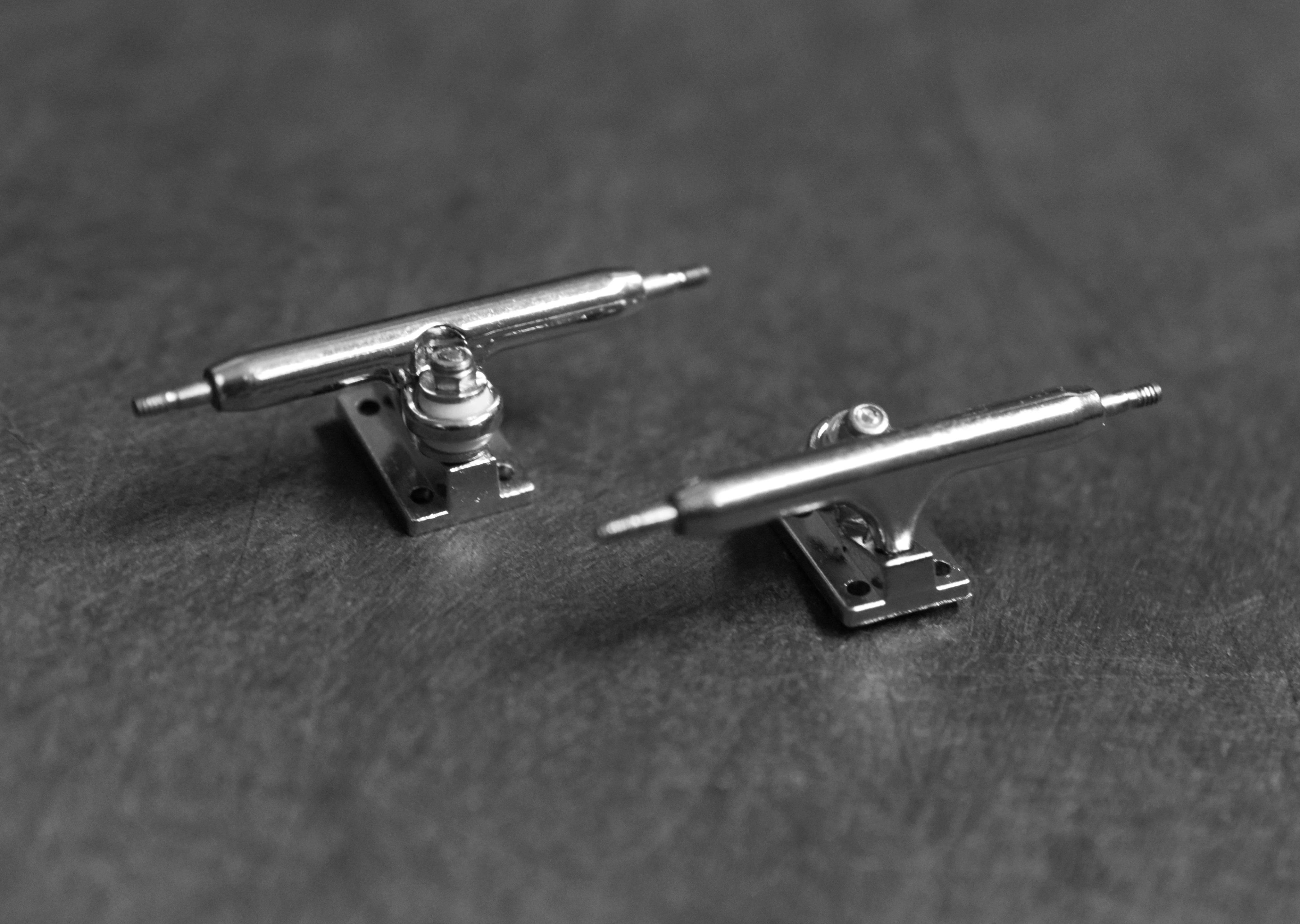
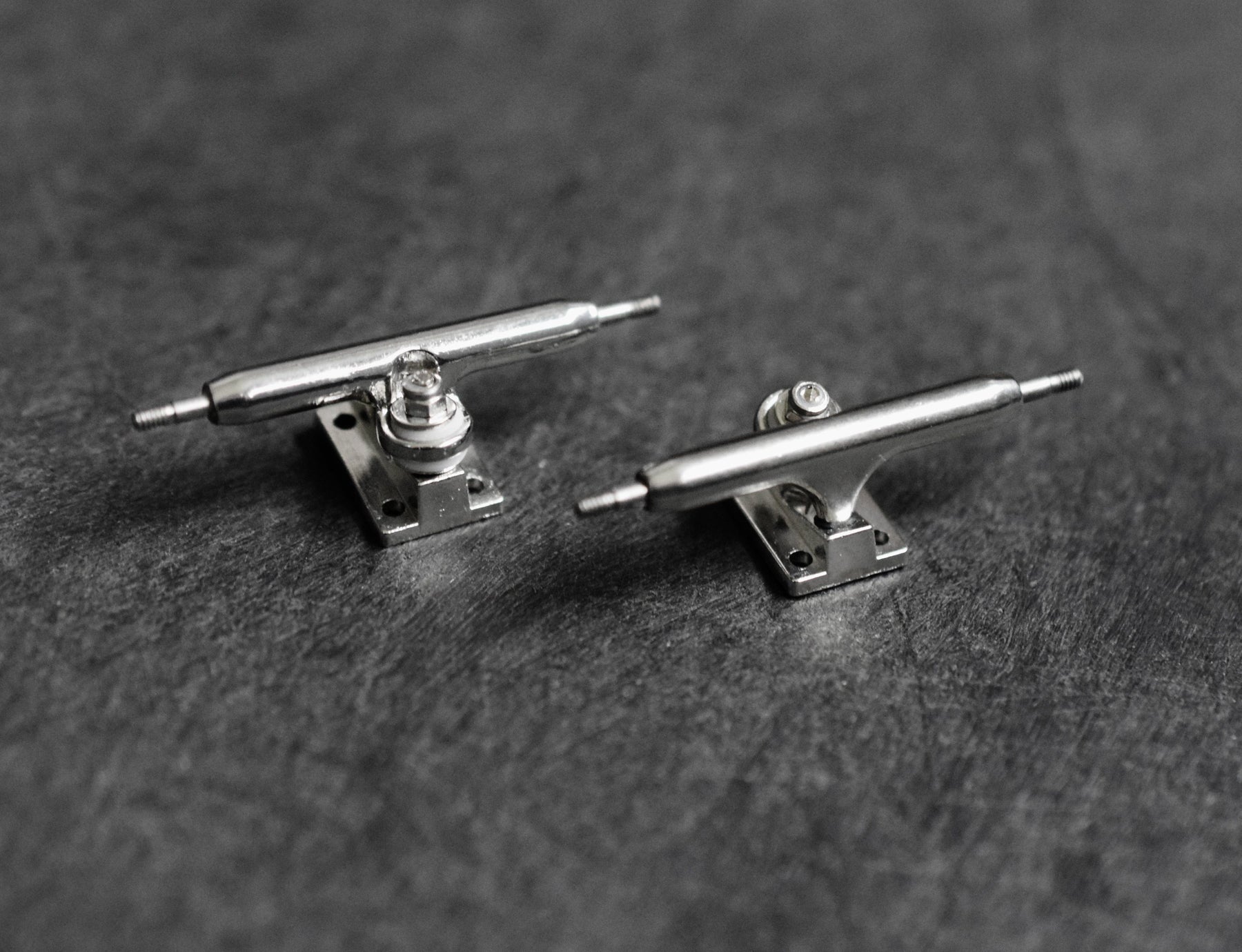
Trucks are the metal components that mount to the underside of your deck, hold your wheels, and allow your board to turn/pivot. They have a baseplate, a hanger, and tuning that controls how loose or tight the turning feels.
What width trucks should I ride on my fingerboard?
Truck width should match your deck width (or be close). For example, A 32mm deck should have 32mm trucks, a 34mm deck should have 34mm trucks.
Not sure which trucks are right for you? Check out our blog: What Trucks Should I Use On My Fingerboard?
How Can I Put My Fingerboard Trucks On So They Don't Fall Off?
Inserting tiny screws with a tiny tool can sometimes be difficult. If your trucks aren’t screwed on properly, they may come loose and fall while riding (and you definitely don't want that).
What are lock nuts and are they included with trucks?
Lock nuts have a nylon insert that grips the axle thread and keeps your wheels from falling off during riding. All Teak Tuning Prodigy Gen2 trucks and completes include them. Need extras? Check out our Teak Tuning Stainless Steel Lock Nuts
What are riser pads in fingerboarding?
Rider pads increase the height of your fingerboard setup and allow more control and a better pop. They also prevent "wheel bite" by increasing the distance between the deck and wheels. Wheel bite is the term for when wheels get worn down from rubbing against the deck when the trucks turn and pivot.
For a full breakdown on Teak Tuning riser pads, check out this guide: What Are Riser Pads In Fingerboarding?
How to avoid stripping your truck holes
"Stripped" trucks or holes means the internal metal threads in a truck baseplate are damaged, worn, or flattened so screws no longer engage properly. The screw spins without tightening or quickly loosens.
For a full breakdown, check out this article: How To Avoid Stripping Your Truck Holes
What are pivot cups and how do I install them?
Pivot cups are small tubes that slide onto the truck hanger and sit inside the baseplate, helping it pivot smoothly and reducing metal-on-metal contact. Many riders love how they feel and the color they add to a setup.
Here is the full breakdown: How To Use Fingerboard Pivot Cups
Which durometer tuning should I use?
In fingerboarding, "durometer" means hardness. A lower durometer number means the product has a softer feeling, and higher durometers mean the product has a harder and firmer feeling.
Check out this guide to figure out which durometer tuning you should ride : Which Durometer Tuning Is Right For Me?
How to install O-Ring Tuning
When Teak Tuning opened back in 2014, the O-Ring Tuning Kits were the first products that Teak launched! Since they work well and are incredibly durable, the O-Ring Tuning Kits are still available today.
Here's a full tutorial and visial in this guide: How To Install O-Ring Fingerboard Tuning
How to install Bubble Bushings
Pro Duro Bubble Bushings are professional shaped bushings for your fingerboard trucks. Each set is molded from an ultra-premium silicone material with a consistent shape and hole placement on every single bushing.
Here's a guide and video that explains how to install them: How To Install Bubble Bushings
Bearing Wheels
- What is "durometer" with fingerboard wheels?
- What is the difference between Teak Tuning's Apex wheels and standard wheels?
- What wheel size and shape should I ride?
- What fingerboard wheels can I ride on a budget?
- Which bearings should I get in my fingerboard wheels? Ultra Spin bearings or ABEC-9 Stealth bearings?
- What if my wheels don't spin?
- My wheels keep falling off. What do I do?
- Why are most fingerboard wheels made of urethane?
- What is "bearing lock" in wheels?
- What are ATP wheels?
What is "durometer" with fingerboard wheels?
Durometer measures wheel hardness on the D scale. You will see ratings like 61D or 71D. Lower durometers numbers are softer and grippier, closer to the feel of real skateboarding. Higher durometer numbers are harder.
What is the difference between Teak Tuning's Apex wheels and standard wheels?
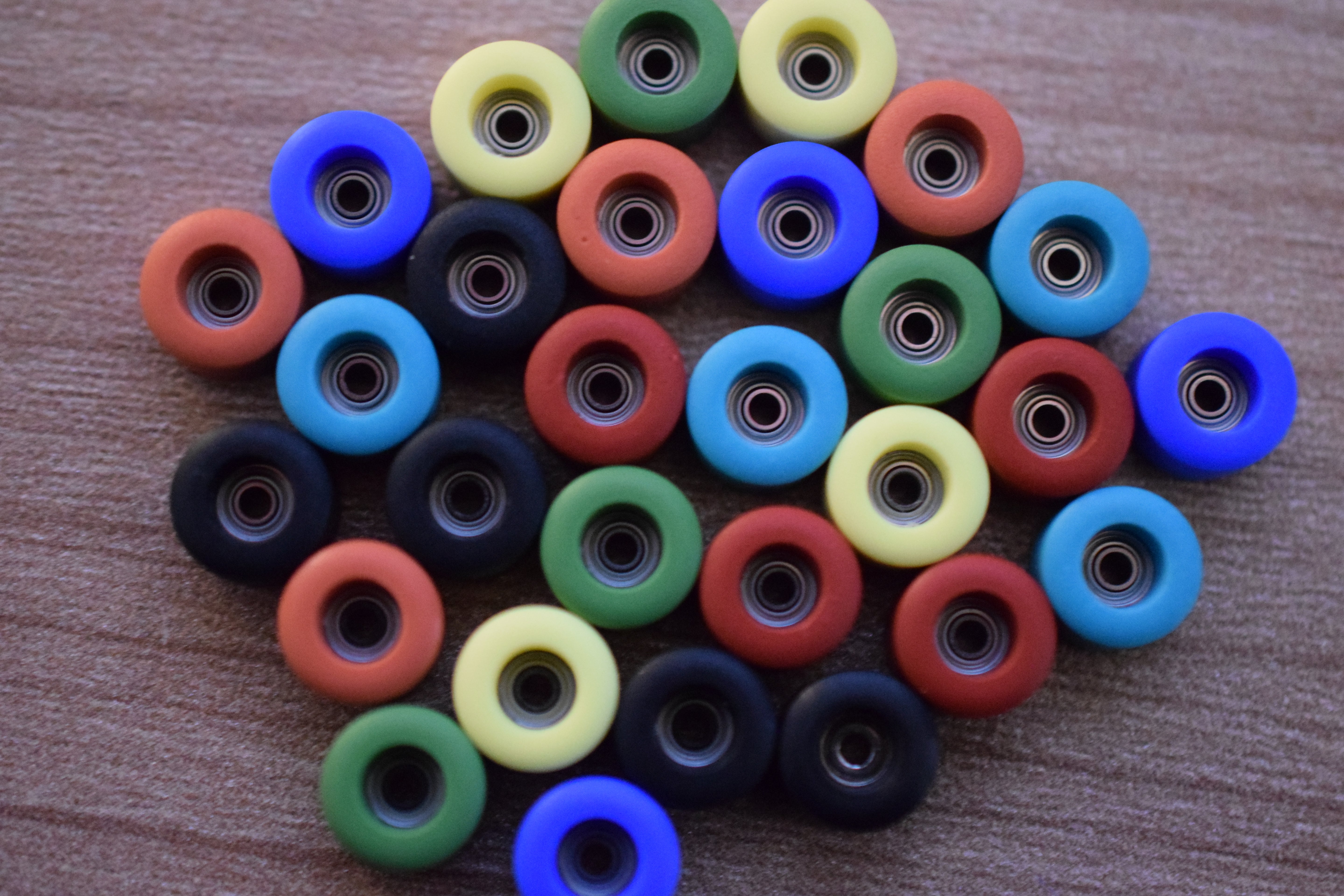
Apex wheels are our premium fingerboard wheels that are made in New York, USA using premium materials. Most Apex Wheels are made from real urethane (just like real skateboard wheels) and we also have other polymer formulas for outdoor riding. Apex wheels are available in multiple shapes, sizes, colors, and durometers.
The full case for upgrading: 10 Reasons Why You Should Upgrade to Apex Wheels
What wheel size and shape should I ride?
Fingerboard wheels coming in many shapes and sizes, and the amount of options can definitely seem overwhelming. At Teak Tuning, our Apex Wheels are made in New York and come in a few different shapes and sizes.
Here's the full breakdown: What Wheel Size and Shape Should Is Best For Me?
What fingerboard wheels can I ride on a budget?
Premium fingerboard wheels can hit your wallet pretty hard at first glance! That's because professional fingerboard wheels are typically handcrafted from top-tier materials. For example, our Apex Wheels are designed and manufactured right here in the USA using only the finest materials and equipment available.
But maybe you're not ready to drop that kind of cash on wheels, or you're just hunting for something more budget-friendly. That's where the CNC Polyurethane wheels come in clutch. These are perfect for anyone working with a tighter budget but still wants solid bearing wheels that actually perform.
Here's the full breakdown: What Wheels Can I Ride On A Budget?
Which bearings should I get in my fingerboard wheels? Ultra Spin bearings or ABEC-9 Stealth bearings?
Teak Tuning offers two bearing options. The ABEC-9 Stealth bearings are incredibly smooth and silent. The UltraSpin bearings are louder and have more free-spin.
For a full side-by-side breakdown: Which Bearings Should I Use: UltraSpin or ABEC-9 Stealth?
What if my wheels don't spin?
If a wheel on your fingerboard won’t spin, it’s usually an easy fix. Here are a few common problems that can cause your wheels to stop spinning (and how to fix them) : What If My Wheel Is Not Spinning?
My wheels keep falling off. What do I do?
Switch from standard hex nuts to locknuts. Locknuts have a nylon insert that grips the axle. Tighten until the wheel spins freely without wobbling, but don't overtighten the lock nuts.
Why are most fingerboard wheels made of urethane?
Urethane is the same material used in real skateboard wheels. It grips naturally, rolls smoothly, holds up over time, and produces that satisfying squeak on ledges and surfaces.
What is "bearing lock" in wheels?
Bearing lock is a design feature built into the wheel that holds the bearing firmly in place so it does not shift or pop out during riding. Teak Tuning Apex wheels use a bearing lock design to keep everything seated securely, so you get a consistent, wobble-free roll every session.
What are ATP wheels?
The ATP (All Terrain Polymer) wheels are a type of Apex Wheels. They are made from a very durable polymer material that is excellent for riding on outdoor sruface or rough surfaces, but they are also great for indoor riding too. You can check them out here.
Obstacles and Rails
- Do I really need fingerboard obstacles or rails?
- What fingerboard obstacles are the best for beginners?
- What is the Monument Series?
- What are Session x Teak obstacles?
- What materials are fingerboard obstacles made of?
- What does acrylic feel like on a fingerboard obstacle?
Do I really need fingerboard obstacles or rails?
Not necessarily, you can fingerboard on anything or create or own. But... fingerboard obstacles are designed specially for fingerboarding and can be a lot of fun to use.
What fingerboard obstacles are the best for beginners?
If you're new to fingerboarding (or you're buying for someone who is), then the best options is any ramp or rail that you can roll onto from the ground. This is becase the rider does not need to know how to ollie or do tricks in order to get onto the obstacle or rail.
Best rail for beginners: Polejam Entrance Rail
Great obstacles for beginners: Kicker Set or Polebank
What is the Monument Series?
The Monument Series is Teak Tuning's line of ultra-premium concrete fingerboard obstacles, designed, hand poured, and manufactured right here in the USA. Each obstacle is custom molded from a unique polymer-modified concrete blend that is smoother and more durable than standard concrete. They develop a natural "real wear" look over time the more you ride them, just like real skateboard obstacles. The series includes kicker ramps, ledges, manual pads, loaf obstacles, jersey barriers, parking curbs, and more. Browse the full collection here: Monument Series Fingerboard Obstacles
What are Session x Teak obstacles?
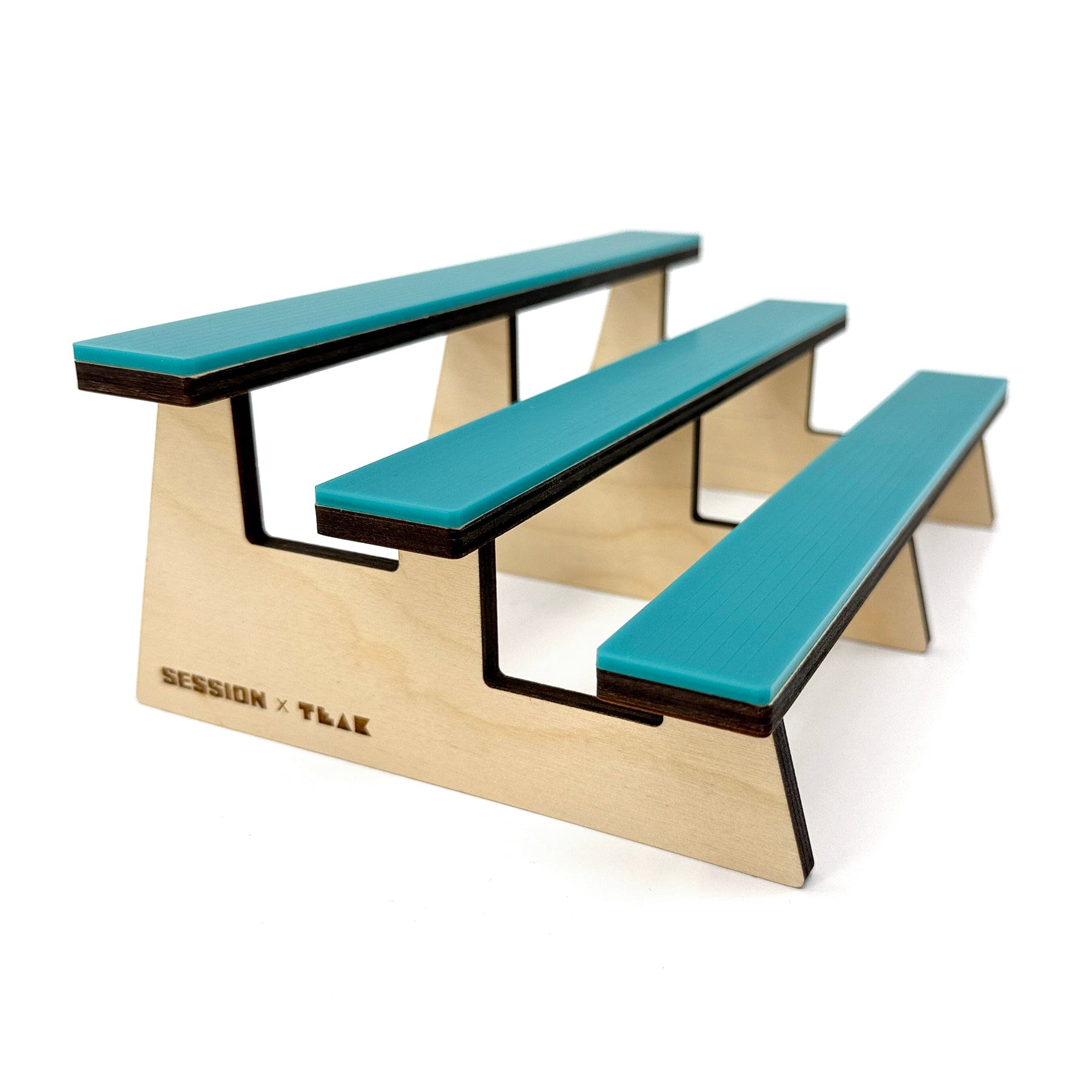
Session x Teak obstacles are a collaborative line of wooden fingerboard obstacles built in partnership with Session Fingerboards. Each piece is handcrafted with the same attention to detail that Session brings to their decks, featuring clean construction and smooth riding surfaces. They are designed to work great individually or combined with other obstacles to build out a full park setup. Browse the full Session Fingerboards lineup at sessionfingerboards.com
What materials are fingerboard obstacles made of?
Fingerboard obstacles are made from many different materials. Wood is the most traditional and works great for ramps and transitions. Concrete is heavier, stays put while you skate, and develops a realistic wear look over time. Acrylic has a super smooth surface that is ideal for ledge tricks and slides. 3D printed obstacles are a newer option that allows for unique shapes at an accessible price point. Many obstacles mix and match multiple materials in a single obstalce.
What does acrylic feel like on a fingerboard obstacle?
Many Session x Teak obstacls feature acrylic riding surfaces. Acrlyic is an ultra-smooth materials that is perfect for fingerboarding, plus it comes in many different colors. Teak x Session obstacles often feature the classic Teak Teal colorway. Check out Session x Teak obstaces here.